F50 Messi Tiers Explained: Elite vs Pro vs League vs Club
adidas sells the Messi signature F50 at four price points, and the spread is wide enough that people assume the boots must be wildly different. They are less different than the prices suggest, and several of the specs quoted confidently about this line actually belong to the non-signature F50, which is a different boot with a different upper.
Here is what is verifiable, what is unsourced, and what nobody outside adidas publishes.
The distinction most tier guides get wrong
There are two F50 families. The standard F50 uses a Fibertouch upper. The Messi signature F50 (the boots this guide is about) uses HybridTouch, the softer, more pliable material adidas also used on the Predator. Retail listings carrying adidas's copy name HybridTouch on the Messi Elite, the Messi Pro and the Messi League. The Club listing names no material beyond "synthetic."
That matters because most tier guides describe the Messi line in standard-F50 vocabulary: Fibertouch uppers, Fiberskin takedowns, compression tunnel tongues. Those terms are real. They belong to the other family. Where this guide quotes a source about the standard F50, it says so.
What the four tiers are and what changes between them
The ladder is Elite (top), Pro, League, Club. In the Messi line the upper material is not the main divide, because three of the four tiers list the same HybridTouch upper. What changes is the soleplate, the tongue, the lining, and the surface the plate is built for.
Soleplate. Every tier gets a different name, and adidas's published retail copy supplies three of the four.
- Elite: Sprintframe 360, firm ground only.
- Pro: Sprintshell 360, firm ground only.
- League: Sprintplate 360, firm ground / multi-ground.
- Club: a firm/multi-ground outsole with no named plate technology.
The practical divide is FG versus FG/MG, not the branding. Elite and Pro are grass boots. League and Club are built to cope with artificial surfaces as well.
Tongue. Elite and Pro use a knit "burrito" tongue that wraps around the foot and gives a wider opening. The League listing describes an "adaptable tunnel tongue" instead; the Club has a lightweight synthetic tongue with punch holes for breathability.
Lining. Elite and Pro list a synthetic lining. League lists a textile lining.
Heel counter. This is usually presented as the Elite/Pro dividing line, and the only documentation we found for it is a review of the standard F50 Pro, not the Messi version: "On the Elite, you get a solid plastic heel counter to keep your foot in place, but the Pro only features a thickened and hardened back that, to be fair, does the job anyway" (Menstuff). We have not found the equivalent confirmed for the Messi signature Pro. Treat it as likely but unverified for this line.
A spec claim to distrust: the carbon plate. You will see the F50 Elite described as having a carbon-fibre plate. adidas's own Sprintframe 360 copy describes "an anatomically designed coring structure for midfoot stiffening" and "a combination of bladed and semi-conical studs." It names no plate material at all. If a page tells you the shelf Elite has a carbon plate, it has not checked.
A spec claim that differentiates nothing: stud shape. "A combination of bladed and semi-conical studs" appears in adidas's copy for the Elite's Sprintframe 360 and for the Pro's Sprintshell 360 alike. Stud shape is not a tier marker, whatever a comparison table tells you.
The comparison table
US list prices for the Messi signature line as carried by retailers in August 2026.
Tier US list Upper Soleplate Tongue Lining Who it's for Elite $270 (FG) HybridTouch, high-definition 3D texture Sprintframe 360, firm ground only Knit burrito Synthetic Competitive players on firm natural grass Pro $160 (FG) HybridTouch Sprintshell 360, firm ground only Knit burrito Synthetic The value pick: same named upper, same tongue, same surface brief League $95 (FG/MG) HybridTouch Sprintplate 360, FG/MG Adaptable tunnel tongue Textile Regular club and school players, mixed grass and artificial surfaces Club Not verified "Synthetic," no named material FG/MG, no named plate technology Lightweight synthetic, perforated; First boots, casual play, and adult buyers who want the look cheapest
On the Club price. adidas lists adult Messi Club SKUs on its own storefront, but we could not retrieve a current US list price for them, so we are not printing one.
On weight. adidas does not publish boot weights on its US listings. Unisport lists 183 g for one Messi Elite FG colourway but states no reference size, which makes the number close to useless for comparison. We have no weight figures at all for the Messi Pro, League or Club, and we are not going to invent them.
Is the Elite worth nearly 3x the League?
At $270 against $95, the Elite is 2.8x the League. Here is the plain answer.
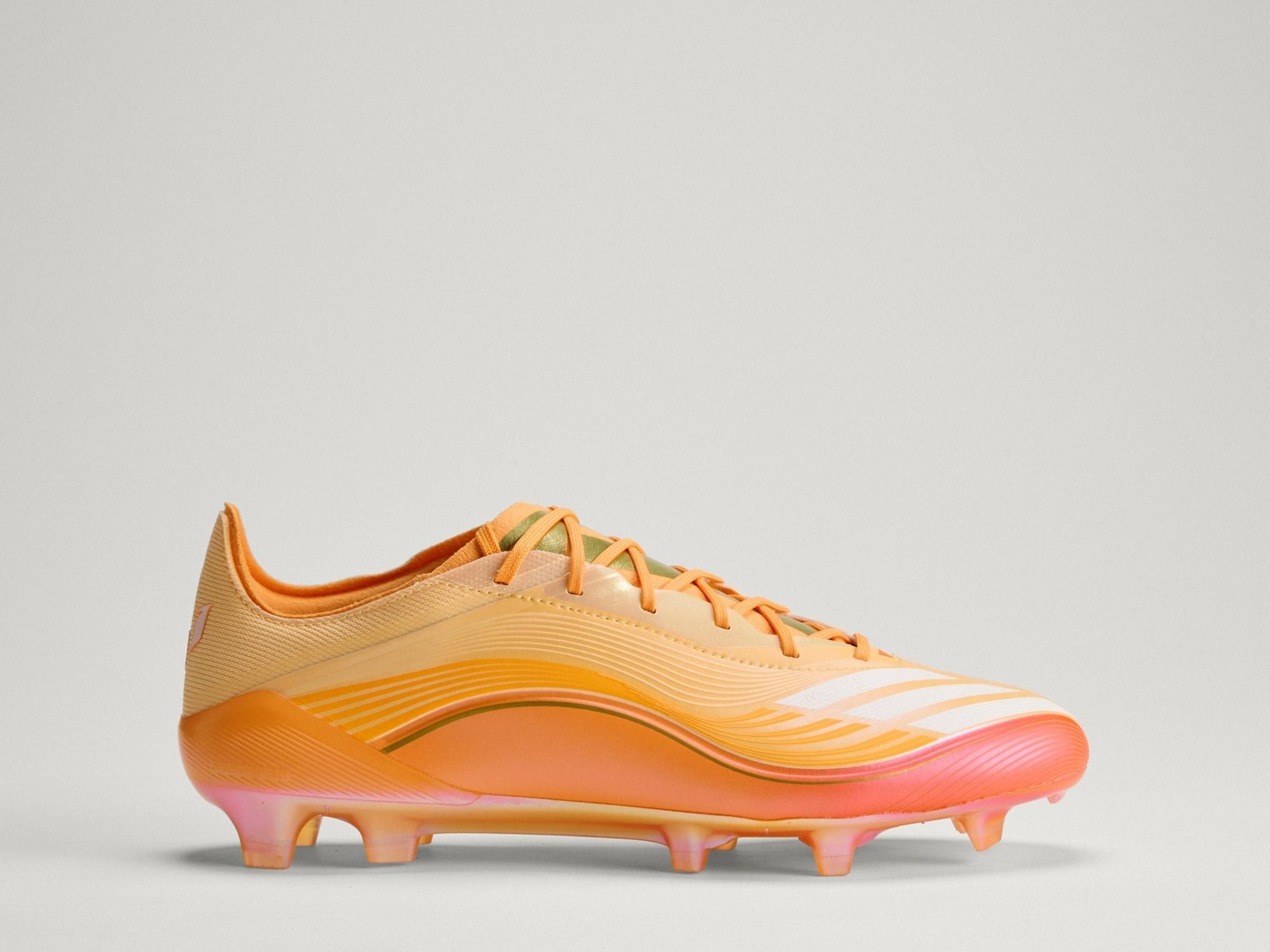
No, for most buyers. What you gain going up is a firm-ground-only plate and a synthetic rather than textile lining. Neither makes an ordinary player faster. If you play once or twice a week on mixed surfaces and your boots see a season or two, the League does the job.
The Elite earns it in two specific cases. First, if you play on real grass, competitively, and the multi-ground plate's shorter studs are costing you grip on soft ground: that is a genuine, physical difference. Second, if you want the boot to look like the boot in the photographs, which is a legitimate reason to spend money as long as you are honest that it is the reason.
The Pro is the answer most people should give. At $160 it carries the same named upper material, the same tongue and the same firm-ground brief as the Elite for 59% of the price. What you give up is the heel structure (likely, on the standard-F50 evidence above, though unconfirmed for the Messi build) and a plate with a different name. That is a narrow sacrifice for a $110 saving. If we only get one sentence, it is the Pro.
Where the Elite is clearly not worth it: for a growing player. A 14-year-old will outgrow a $270 boot in a season. Buy League.
Fit and width
Be careful here, because two different boots get confused constantly.
The standard F50 is a narrow speed boot. The Messi signature build is reported to be friendlier: footballboots.co.uk describes the Messi F50's HybridTouch as "softer than the regular F50," with "a touch more forefoot width," and calls it "kinder to a wide foot than the standard F50, which runs narrow." It also warns the wrap-around tongue "can bunch a little on the inside of the foot where it folds in."
One correction worth making loudly: the fit-database quotes about a "narrow" forefoot and a "low tapered" toe box that circulate for this boot come from the F50 Hyperfast Elite entry, the May 2026 next-generation platform, not the HybridTouch Messi Elite. That data may not transfer, and we are not treating it as though it does.
adidas publishes no width specs at any tier. Elite and Pro share the HybridTouch upper and the knit burrito tongue, so they should feel much alike through the forefoot; beyond that there is nothing tier-specific we can tell you.
If your feet are genuinely wide, a wider adidas last is still a better answer than forcing an F50 half a size up, but the blanket claim that no F50 works for a wide foot does not survive contact with the Messi build.
What Messi actually wears
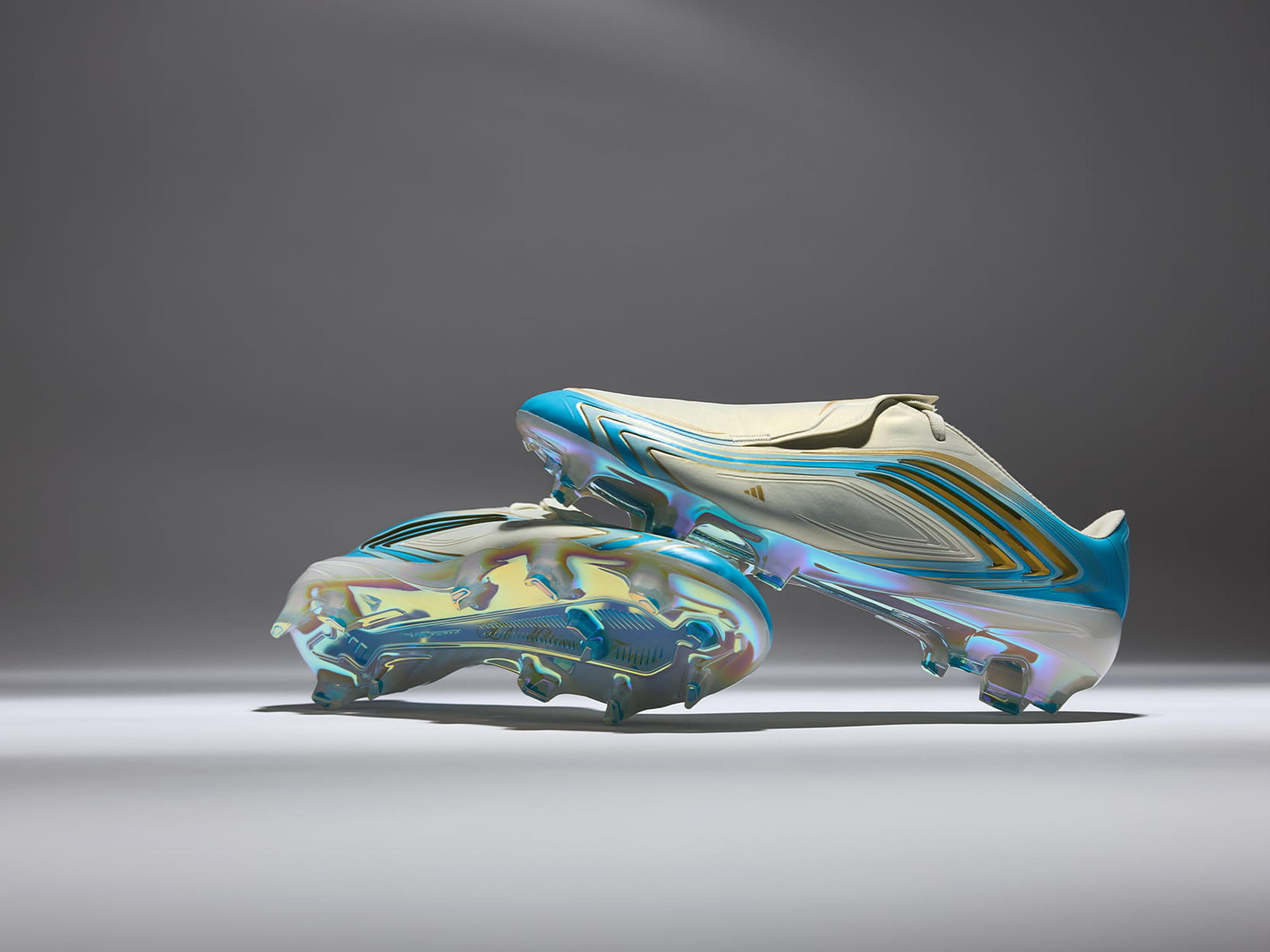
Elite, always, and never quite the retail version.
What is sourced. SoccerBible's coverage of one of his F50 pairs (published 20 March 2014) lists the customisation as "the Messi Icon logo, Argentinian flag, Leo 10 and acknowledgement to his newborn son Thiago" (SoccerBible). That is what we can stand behind.
What is not. The widely repeated claims that his uppers carry all three sons' names and birthdates, that "ANTO" appears for Antonela, and that the tradition began the day after Thiago's birth, we could not source to anything that actually says so. So this guide does not say so either.
What matters for shopping is unaffected: no retail tier, Elite included, ships with personalisation. Any listing claiming otherwise is describing a custom job or a fake. See the full run in the F50 line archive or the complete timeline.
What he actually wears changes with the season, so this guide doesn't pin a single colorway to a date: see What cleats does Messi wear right now for the current answer, updated whenever he switches. What doesn't change with the colorway: he plays in the Elite tier, and his match pairs are individually finished rather than a stock pair off the shelf.
How the takedowns differ from the boot in the photos
Marketing photography is shot on the Elite. Three things change on the way down and none of them show up in the images:
- The plate changes surface brief. League and Club move to FG/MG. Side by side with the Elite's firm-ground-only Sprintframe 360, the sole is a different object.
- The tongue changes. The knit burrito wrap on Elite and Pro becomes a tunnel tongue on League and a perforated synthetic tongue on Club.
- The lining changes. Synthetic on Elite and Pro, textile on League.
The first of those is also the most useful practical difference in the range, and it is undersold everywhere: an FG/MG plate is genuinely better on artificial grass and hard, dry pitches. If most of your football happens on 3G, the League is not a compromise on the Elite. It is the more appropriate plate.
Sizing guidance
adidas lists every Messi tier as "regular fit," and we have no width data to go past that. Practical advice:
- Normal or narrow feet: take your usual football boot size in any tier.
- Slightly wide or high-volume feet: the Messi build's softer upper gives you more room than the standard F50, but a half size up is the safer call if you are between sizes.
- Buying for a child: League or Club, true to size, and do not size up "for growth." A loose speed boot is a blister factory.
Try before you commit where you can. No amount of spec reading substitutes for putting a foot in one.
Note on the 2026 generation change
adidas released a next-generation platform, the F50 Hyperfast, on 7 May 2026 as part of a "Too Light" pack, with an entirely new vocabulary: HALOSKIN+, HALOSHELL+, HALOCAGE+ and HALOBELT+ uppers over an F50 SPEEDSYSTEM+ plate. Footy Headlines reports the limited Evo model at 130 g and the laceless version at 170 g.
That platform sits alongside the Messi tier ladder above rather than replacing it: the Messi Elite is still listed with HybridTouch over Sprintframe 360. adidas has not published a tier-by-tier breakdown of the Hyperfast platform in any source we have reviewed, so we cannot yet say how its Pro, League and Club takedowns will be built. We will update this guide when it does.
Where to look: the adidas Messi storefront for current-season stock, StockX and eBay for sold-out colourways. messicleats.com earns a commission on some outbound links. It does not affect what we write; we have told you above not to buy the expensive one.
Related: Best Messi Boots to Buy in 2026 and the Vintage Messi Boots Collector's Guide.
Frequently asked
How much do the adidas F50 Messi tiers cost in August 2026?
US list prices we could confirm from retailers carrying adidas's copy: Elite FG $270, Pro FG $160, League FG/MG $95. We could not verify a current US adult list price for the Messi Club from any retailer, so we are not quoting one. The kids' Messi Club we could check lists at $49.99.
What is the difference between the Messi F50 and the standard F50?
Mainly the upper. The standard F50 uses Fibertouch; the Messi signature F50 uses HybridTouch, the softer and more pliable material adidas also used on the Predator. Retail listings carrying adidas's copy name HybridTouch on the Messi Elite, Pro and League. The Messi build also uses a knit wrap-around 'burrito' tongue rather than the standard line's compression tunnel tongue. Most tier guides describe the Messi boots in standard-F50 vocabulary, which is where a lot of confidently wrong spec sheets come from.
Is the F50 Messi Elite worth nearly three times the price of the League?
For most players, no. At $270 against $95 the Elite is 2.8x the League, and both list the same HybridTouch upper. What you actually gain going up is a firm-ground-only Sprintframe 360 plate instead of the League's FG/MG Sprintplate 360, and a synthetic rather than textile lining. The Elite earns its price if you play competitively on real grass and the multi-ground plate's shorter studs cost you grip, or if you want the boot from the photographs and are honest that this is why. Otherwise the Pro at $160 is the better buy.
What is the difference between the F50 Messi Pro and the F50 Messi Elite?
Less than the $110 price gap suggests. Both list the same HybridTouch upper, the same knit burrito tongue, the same synthetic lining and the same firm-ground-only brief. adidas names the plates differently: Sprintframe 360 on the Elite, Sprintshell 360 on the Pro. The heel is usually cited as the dividing line, but the only documentation we found is a review of the standard, non-signature F50 Pro, which reports a solid plastic heel counter on the Elite and a thickened, hardened back on the Pro. We have not found that confirmed for the Messi signature Pro.
Do adidas F50 Messi boots run true to size?
adidas lists every Messi tier as 'regular fit' and publishes no width specs, so there is not much to go past that. Take your usual football boot size in any tier. If you are between sizes, or your feet are slightly wide or high-volume, a half size up is the safer call. Do not size up for a child to grow into; a loose speed boot causes blisters.
Are F50 Messi boots good for wide feet?
Better than the standard F50, which runs narrow. footballboots.co.uk describes the Messi build's HybridTouch upper as 'softer than the regular F50,' with 'a touch more forefoot width,' and calls it 'kinder to a wide foot than the standard F50.' It also warns the wrap-around tongue 'can bunch a little on the inside of the foot where it folds in.' Note that the fit-database quotes about a 'narrow' forefoot and 'low tapered' toe box that circulate for this boot describe the F50 Hyperfast Elite, a different, next-generation platform, and may not transfer. For genuinely wide feet, a wider adidas last is still a better answer.
Does the F50 Elite have a carbon fibre plate?
adidas does not say so. Its published Sprintframe 360 copy describes 'an anatomically designed coring structure for midfoot stiffening' and 'a combination of bladed and semi-conical studs,' and names no plate material at all. Pages asserting a carbon plate on the retail Elite are repeating an unverified claim. Worth noting too that the same 'bladed and semi-conical studs' wording appears in adidas's copy for the Pro's Sprintshell 360, so stud shape does not distinguish the tiers either.
What does Messi actually wear, and can you buy the same boot?
He wears the Elite tier, always, but which colorway is current changes with the season, so see our "What cleats does Messi wear right now" page rather than relying on a date stamped here. What's fixed regardless of colorway: you can buy the same construction but not the same boot. His match pairs are individually finished: SoccerBible's coverage of one such pair (published 20 March 2014) lists "the Messi Icon logo, Argentinian flag, Leo 10 and acknowledgement to his newborn son Thiago." Claims that his uppers carry all three sons' names and birthdates, or "ANTO" for Antonela, we could not source and do not repeat. No retail tier ships with personalisation of any kind.